Retrochallenge 2016/10
I decided to join in with ` <http://www.wickensonline.co.uk/retrochallenge-2012sc/>`__Retrochallenge 2016/10 this October. I'm also hoping this will provide some incentive to write more posts and updates about other projects once I'm back into the swing of things!
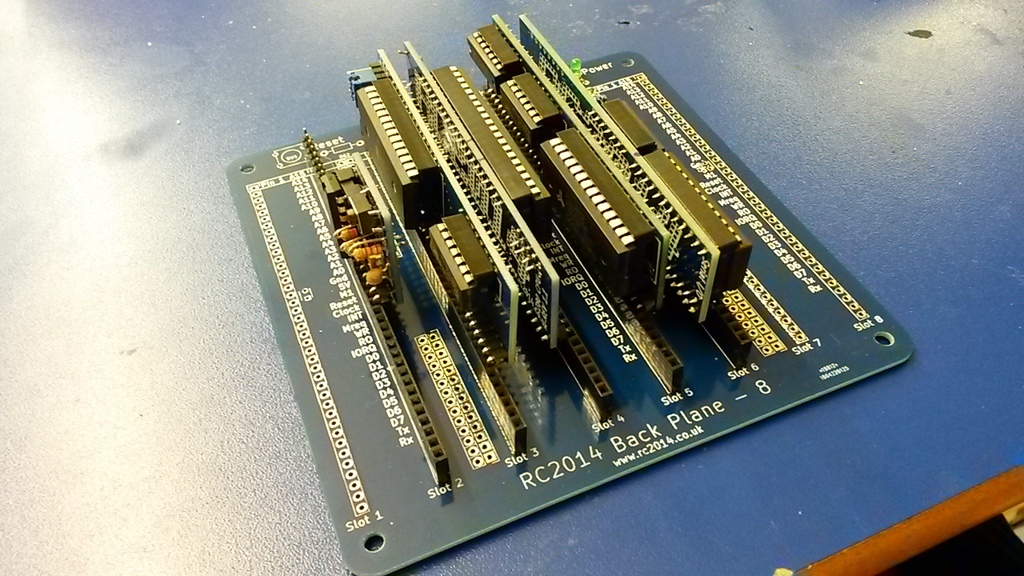
My goal for this Retrochallenge is to finish an SD card interface I started designing for Spencer Owen's ` <http://rc2014.co.uk/>`__RC2014 Z80 based computer (which was spawned by a previous Retrochallenge, hence the name). This should work with most Z80 computers that don't do anything crazy to the I/O interface, so I may also get it working on a ZX Spectrum if there is time.
I'm intending to build my SD interface from 74 series and similar discrete logic ICs. This is partly for fun and partly because the microcontroller in the SD card is likely already more powerful than the RC2014. Adding another microcontroller into the mix to interface with the one in the SD card is just a step too far.
I'll be using the SPI-like mode of the SD card protocol, not least because information on the faster SD mode is not publicly available. The SPI-like interface should allow me to use shift registers for communication with the SD card.
I was initially planning to use a 74ALS299 universal shift register to reduce chip count. Unfortunately, in addition to being somewhat hard to get, the interface on this chip is troublesome as the shift, shift direction, and output enable are all synchronous and controlled via two pins that set the operation. The extra glue logic needed to deal with this completely nullifies the benefit of using a single universal shift register. Because of this I'm planning to redesign around a pair of shift registers: a 75HCT595 serial-in-parallel-out register and a 75HTC165 parallel-in-serial-out register.
The SD card requires a slow clock pulse for initialisation (around 100khz), but once initialised supports faster clock speeds. The design is complicated by the need to run at both speeds, but I have a scheme to cope with this.
My intended interface uses a pair of registers mapped to the Z80's I/O space.
DATA
- Writes to this address latch the byte from the Z80 data bus into the 74HTC165 which is used to send data to the SD card.
- Reads from this address enable the outputs on the 74HTC595 shift register which receives data from the SD card.
CONFIG
Writes to this address update a 74HTC374 register holding a configuration byte. The following bits are currently used:
- autoshift - Automatically shift 8 bits from the shift registers to the SD card and back after a write to the DATA address. This is used for the SD card's "normal" high speed mode and should allow fast enough I/O that the Z80 becomes the bottleneck.
- clock - OR'd with the automatic clock signal to the shift registers and SD card, allowing communication at a speed controlled directly by the Z80 to provide a 'bitbang' mode. This mode is not efficient, but allows the slower speed required for the SD card initialisation process without much extra logic.
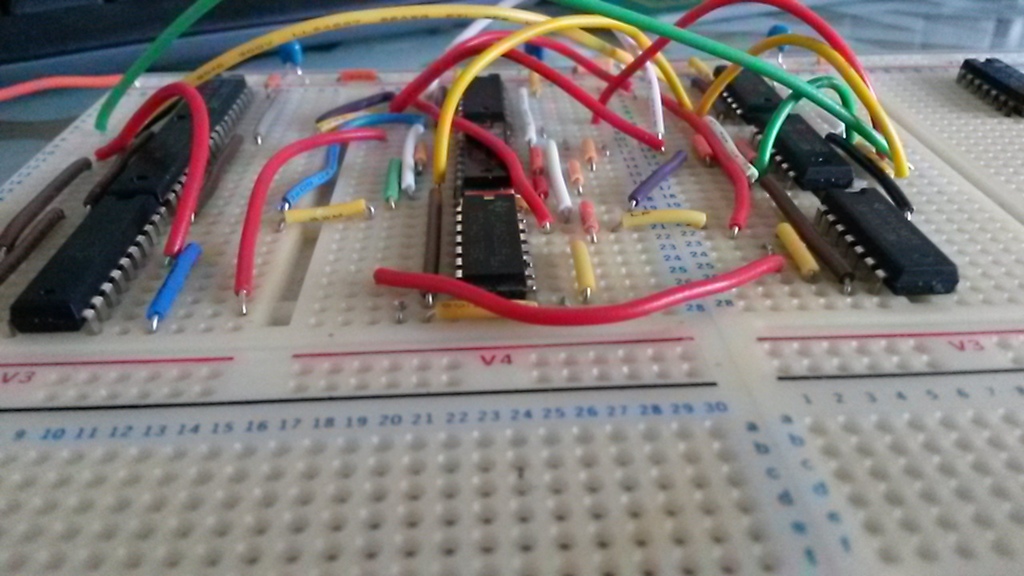
An initial version similar to this design has been built on a breadboard using a 74ALS299. In addition to the issues with the synchronous control signals needed to load this shift register, there were also compatibility issues with the timing of the Z80's I/O control signals. This requires additional glue logic and a redesign of automatic shifting logic that enables the high speed mode to work.
Before I take the previous version apart to rebuild, I'll take some logic analyser captures indicating the timing issues, and write up (and remind myself of) the problems.